Knicks vs Milwaukee Bucks Match Player Stats
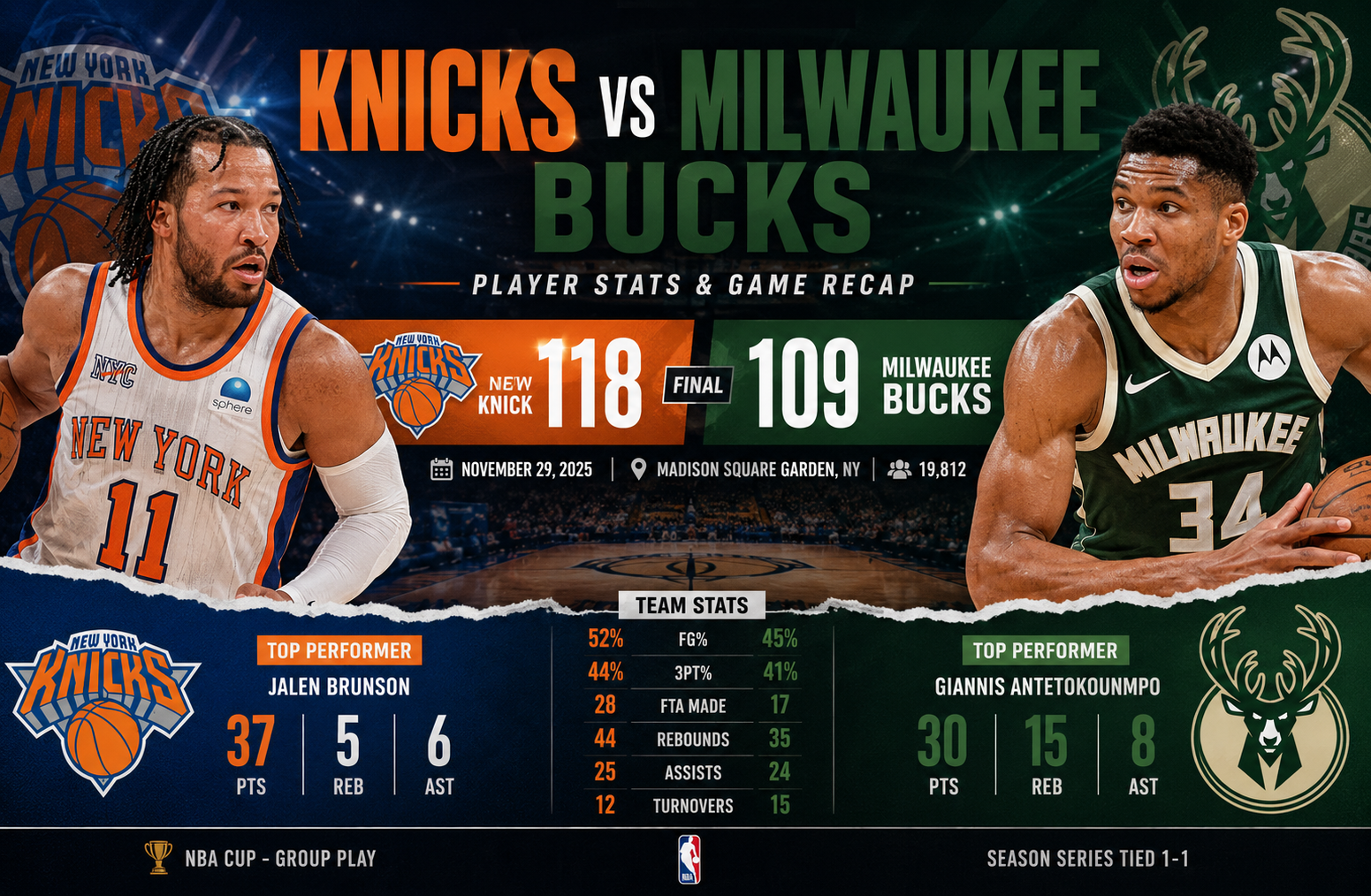
Knicks vs Milwaukee Bucks match player stats from the November 29, 2025 NBA Cup Group Play matchup tell the story of a game that was far more competitive than the final nine-point margin suggests. The New York Knicks defeated the Milwaukee Bucks 118-109 at Madison Square Garden, with Jalen Brunson delivering a game-high 37 points while Giannis Antetokounmpo produced a dominant 30-point, 15-rebound, 8-assist performance for Milwaukee.
The game also carried significant tournament importance. New York improved to 3-1 in East Group C and clinched the group, while Milwaukee was eliminated from the NBA Cup after falling to 2-2 in group play. The Knicks entered the contest with a 12-6 record and a 9-1 home mark, while the Bucks came in at 8-12 overall and 3-6 on the road.
The most interesting part of the matchup was the contrast between individual excellence and team execution. Milwaukee shot better from the field and made more three-pointers, yet New York controlled the glass, converted its free throws at a much higher rate, committed fewer turnovers, and produced the decisive plays late in the game.
Knicks vs Milwaukee Bucks Match Player Stats
The final score was New York Knicks 118, Milwaukee Bucks 109.
| Category | Milwaukee Bucks | New York Knicks |
| Final Score | 109 | 118 |
| Q1 | 37 | 33 |
| Q2 | 25 | 28 |
| Q3 | 26 | 31 |
| Q4 | 21 | 26 |
| Field Goals | 37/71 | 38/84 |
| Field Goal % | 52.1% | 45.2% |
| Three-Pointers | 18/41 | 14/34 |
| Three-Point % | 43.9% | 41.2% |
| Free Throws | 17/25 | 28/33 |
| Free Throw % | 68.0% | 84.8% |
| Total Rebounds | 35 | 44 |
| Assists | 24 | 25 |
| Turnovers | 15 | 12 |
| Steals | 9 | 10 |
| Blocks | 4 | 2 |
| Personal Fouls | 26 | 21 |
At first glance, the statistics appear to favor Milwaukee in several shooting categories. The Bucks made 52.1% of their field-goal attempts compared with New York’s 45.2%, and they knocked down 18 three-pointers against 14 for the Knicks.
But basketball games are not decided by shooting percentage alone. New York gained a major advantage at the free-throw line, winning the rebounding battle 44-35 and protecting the ball better. Those smaller advantages helped offset Milwaukee’s superior shooting efficiency.
The nine-point final margin therefore makes sense when the complete statistical profile is considered. Milwaukee was more efficient from the floor, but New York created more opportunities and converted those opportunities more reliably in high-value situations.
Jalen Brunson Leads New York With 37 Points
Jalen Brunson was the defining offensive player of the game.
The Knicks guard finished with 37 points, 5 assists, 1 rebound, and 1 steal, shooting 12-of-21 from the field, 4-of-6 from three-point range, and 9-of-10 from the free-throw line. His 57.1% field-goal shooting and 66.7% three-point shooting were especially important because Milwaukee was generating efficient offense on the other end.
Brunson’s performance was not simply a matter of accumulating points. His scoring came at moments when New York needed to answer Milwaukee’s runs.
The third quarter was particularly important. According to the game recap, Brunson made seven of eight shots during the period as the Knicks turned a one-point halftime deficit into a four-point advantage entering the fourth. That sequence changed the rhythm of the game. Instead of allowing Milwaukee to dictate the contest through its superior shooting, New York placed the game back in the hands of its primary creator.
Brunson’s fourth-quarter contribution was equally valuable. When Milwaukee attempted to recover from an early 13-point deficit in the final period, Brunson responded with free throws, playmaking, and a crucial three-point play.
His final line:
- 37 points
- 12-of-21 field goals
- 4-of-6 three-pointers
- 9-of-10 free throws
- 5 assists
- 1 rebound
- 1 steal
- 3 turnovers
- +10 plus/minus
From an analytical perspective, Brunson’s biggest value was his ability to combine volume with efficiency. He took 21 shots, but he did not need an excessive number of attempts to reach 37 points. He also generated additional value by getting to the line 10 times.
That combination is one reason his performance stands out when reviewing the Knicks vs Milwaukee Bucks match player stats.
Giannis Antetokounmpo Produces an All-Around Masterclass
Giannis Antetokounmpo was Milwaukee’s best player and arguably the most statistically complete performer on either team.
He finished with:
- 30 points
- 15 rebounds
- 8 assists
- 1 steal
- 3 turnovers
- 5 personal fouls
- 10-of-14 field goals
- 10-of-14 free throws
- 28:05 minutes
Giannis shot 71.4% from the field, making him one of the most efficient high-volume scorers in the game. His 15 rebounds were also tied for the game high, while his eight assists showed how heavily Milwaukee relied on his ability to create offense.
What makes the performance more notable is that this was his return after missing four games because of a groin injury, according to the Associated Press recap carried by the NBA. Despite the absence, he immediately produced at an elite level.
The limitation was not Giannis himself. The bigger issue was that Milwaukee needed more consistent production around him during the decisive stretches.
His plus/minus was +2, which is notable because the Bucks still lost by nine points. That figure suggests that the minutes featuring Giannis were highly competitive, while New York’s advantage emerged more strongly during stretches when the Knicks were able to exploit Milwaukee’s depth and perimeter coverage.
His statistical profile also highlights why box-score analysis should go beyond scoring. A 30-point game is impressive. A 30-point game with 15 rebounds and eight assists is a complete offensive and rebounding performance.
For Milwaukee, the central challenge was turning that individual dominance into a winning team result.
Josh Hart’s 19-Point Double-Double Impact
Josh Hart produced one of the most important supporting performances for New York.
He recorded:
- 19 points
- 15 rebounds
- 7 assists
- 3 steals
- 4 personal fouls
- 5-of-12 field goals
- 9-of-10 free throws
- +15 plus/minus
The 15 rebounds were especially valuable because Milwaukee had a clear shooting advantage. When one team shoots 52.1% and the other shoots 45.2%, the less efficient team needs to compensate elsewhere.
New York did exactly that.
Hart’s rebounding helped the Knicks finish with a 44-35 advantage on the boards, a nine-rebound difference. His seven assists also helped New York maintain offensive flow without relying entirely on Brunson to create every possession.
The most revealing number may be his +15 plus/minus, the best mark among the Knicks’ regular rotation players.
Hart’s contribution illustrates why player statistics should be viewed in context. He was not New York’s leading scorer, but his combination of rebounding, passing, defense, and free-throw shooting directly addressed areas where the Knicks needed an advantage.
His 15 rebounds matched Giannis’ total, giving New York a major contribution from a player whose primary value is often measured beyond scoring.
Miles McBride Provides the Fourth-Quarter Spark
Miles McBride scored 19 points and was one of the most influential players in the game’s final stretch.
He shot:
- 5-of-8 from the field
- 5-of-7 from three-point range
- 4-of-4 from the free-throw line
McBride’s three-point shooting was particularly important. His five made threes came on only seven attempts, giving New York efficient perimeter production at a time when the Bucks were trying to close the gap.
The game recap specifically highlighted McBride’s role at the start of the fourth quarter. He made two three-pointers early in the period, helping New York establish a 101-88 lead. Milwaukee later responded, but McBride’s early fourth-quarter shooting gave the Knicks the cushion they needed.
His final plus/minus of +14 further supports the impact of his minutes.
McBride’s performance is one of the clearest examples of how the Knicks won the game as a team. Brunson was the primary star, Hart provided the all-around production, but McBride supplied the perimeter scoring that helped New York withstand Milwaukee’s comeback attempts.
Milwaukee Bucks Player Stats Breakdown
Milwaukee received strong individual performances from several players, even though the team could not finish the game.
Giannis Antetokounmpo
30 points, 15 rebounds, 8 assists
Giannis was the Bucks’ leading scorer, rebounder, and assist leader. His 71.4% shooting from the field was outstanding, and he came within two assists of a triple-double.
His return was one of the major storylines of the game, and his production showed that he was immediately capable of carrying a substantial offensive workload.
Kyle Kuzma
20 points, 4 rebounds, 3 assists
Kuzma was Milwaukee’s second-highest scorer. He shot an exceptional 8-of-9 from the field and made 4-of-5 attempts from three-point range.
That 88.9% field-goal percentage is one of the most efficient individual shooting performances in the game.
However, his -11 plus/minus shows the difference between individual shooting efficiency and overall lineup performance. Kuzma was highly effective as a scorer, but Milwaukee still lost the minutes in which he was on the floor.
A.J. Green
18 points, 5 rebounds, 1 assist, 2 steals
Green was a major factor from beyond the arc. He made 6-of-12 three-point attempts, accounting for all 18 of his points.
His shooting helped Milwaukee finish with 18 made threes as a team, compared with 14 for New York.
The Bucks’ perimeter efficiency was therefore not the reason they lost. Their problem was that their strong three-point shooting was not enough to overcome New York’s advantages in other areas.
Ryan Rollins
13 points, 5 rebounds, 6 assists, 2 steals, 2 blocks
Rollins contributed across multiple categories. His six assists were second only to Giannis among Milwaukee players, while his two steals and two blocks showed defensive activity.
His plus/minus was 0, meaning the game was essentially even during his minutes.
Myles Turner
10 points, 3 rebounds, 1 assist, 1 steal, 2 blocks
Turner made 3-of-10 field goals and 2-of-7 three-pointers.
His two blocks were tied for the team lead, but his offensive efficiency was limited. Against a Knicks lineup that finished with 44 rebounds, Milwaukee needed more consistent interior production and rebounding support.
Gary Harris
5 points, 0 rebounds, 0 assists
Harris shot 1-of-2 from the field and made his only three-point attempt.
His role was limited compared with some of Milwaukee’s other rotation players.
Cole Anthony
7 points, 0 rebounds, 2 assists
Anthony was perfect from the field, going 3-of-3, but he attempted only three shots and played fewer than seven minutes.
Bobby Portis
3 points, 3 rebounds, 2 assists
Portis struggled offensively, shooting 1-of-7 from the field.
His limited scoring was notable because Milwaukee needed more production from its bench to match New York’s supporting cast.
Gary Trent Jr.
3 points, 0 rebounds, 1 assist
Trent Jr. shot 1-of-4 from the field and finished with a -6 plus/minus.
Players Who Did Not Play
The Bucks listed the following players as DNP, coach’s decision:
- Thanasis Antetokounmpo
- Jericho Sims
- Amir Coffey
- Andre Jackson Jr.
- Mark Sears
The complete box score confirms the player-by-player figures and playing-time distribution.
New York Knicks Player Stats Breakdown
New York’s success was built around a strong combination of star scoring and complementary production.
Jalen Brunson
37 points, 5 assists, 1 rebound
Brunson was the clear offensive centerpiece.
His 37 points were the highest total in the game, and his ability to score efficiently against a Milwaukee team shooting at a higher overall percentage was central to the result.
Josh Hart
19 points, 15 rebounds, 7 assists, 3 steals
Hart delivered the most balanced statistical performance outside of Giannis.
His 15 rebounds were particularly important in a matchup where the Knicks needed extra possessions to offset Milwaukee’s superior shooting.
Miles McBride
19 points, 2 rebounds, 1 assist
McBride was arguably the key difference-maker among the secondary scorers.
His 5-of-7 shooting from three-point range gave New York a major efficiency boost and his fourth-quarter shot-making helped prevent Milwaukee from fully taking control.
Mikal Bridges
14 points, 4 rebounds, 2 assists, 2 steals, 1 block
Bridges shot 6-of-12 from the field and 2-of-5 from three-point range.
His defensive contributions were also valuable, with two steals and a block.
He finished with a +3 plus/minus, reflecting a positive overall impact even without a huge scoring total.
Karl-Anthony Towns
9 points, 10 rebounds, 4 assists, 1 block
Towns had an unusual offensive night by his standards, shooting 2-of-8 from the field.
Yet his overall contribution remained useful. He collected 10 rebounds, including three offensive boards, and added four assists.
This is an important reminder that a player can contribute to a win without having an efficient scoring night.
Jordan Clarkson
6 points, 4 rebounds, 3 assists
Clarkson struggled with his shooting, making only 2-of-13 attempts.
However, he still contributed four rebounds and three assists while finishing with a +9 plus/minus.
Mitchell Robinson
6 points, 7 rebounds, 1 assist, 2 steals
Robinson was highly efficient from the field, going 3-of-3.
His seven rebounds and two steals helped strengthen New York’s defensive and rebounding presence.
Tyler Kolek
5 points, 1 assist, 2 steals
Kolek played 10:15 and made a key three-pointer during the fourth-quarter stretch that helped New York establish its early advantage.
Guerschon Yabusele
3 points, 1 rebound, 1 assist
Yabusele played just over six minutes and made his only field-goal attempt.
Players Who Did Not Play
The Knicks listed these players as DNP, coach’s decision:
- Tosan Evbuomwan
- Pacôme Dadiet
- Mohamed Diawara
- Ariel Hukporti
The full statistical breakdown is available through the official NBA box score.
Why the Knicks Won Despite Shooting Worse
One of the most valuable lessons from this matchup is that field-goal percentage does not tell the entire story.
Milwaukee shot 52.1% from the field.
New York shot 45.2%.
On the surface, that should suggest a Milwaukee victory.
But New York won 118-109.
Why?
The answer is a combination of possession control, free-throw efficiency, rebounding, and late-game execution.
1. New York Won the Rebounding Battle
The Knicks grabbed 44 rebounds compared with 35 for Milwaukee.
That nine-rebound advantage mattered because it helped compensate for the Bucks’ superior shooting.
Josh Hart led the way with 15 rebounds, while Karl-Anthony Towns added 10 and Mitchell Robinson contributed seven.
New York also collected 14 offensive rebounds compared with only five for Milwaukee.
That difference created extra opportunities.
2. The Knicks Were Much Better at the Free-Throw Line
New York made 28-of-33 free throws, an 84.8% conversion rate.
Milwaukee made 17-of-25, or 68%.
That created an 11-point advantage in made free throws.
In a nine-point game, that difference was enormous.
The Knicks did not merely get to the line more often. They also converted at a much higher rate.
Brunson and Hart each made nine free throws, combining for 18 of New York’s 28 successful attempts.
3. New York Protected the Basketball Better
The Knicks committed 12 turnovers.
The Bucks committed 15.
The difference was only three turnovers, but in a competitive game, three additional possessions can matter.
New York also finished with 10 steals compared with nine for Milwaukee, meaning the Knicks were able to create some defensive activity while simultaneously limiting their own mistakes.
4. The Knicks Executed Better Late
The fourth quarter was decisive.
Milwaukee entered the period trailing 92-88.
New York then opened the quarter with a scoring burst that pushed the lead to 101-88.
McBride’s three-point shooting was critical, while Kolek also contributed from deep.
Milwaukee fought back, but New York had enough offensive answers to close the game.
Brunson’s late free throws and three-point play were particularly important.
The game therefore demonstrates a broader basketball principle: the best shooting team does not always win when the opponent creates more possessions, reaches the free-throw line more frequently, and executes better in high-leverage moments.
The Third Quarter Was the Turning Point
The Bucks led 62-61 at halftime after winning the opening half 62-61.
That was significant because Milwaukee had already demonstrated that it could score efficiently against New York’s defense.
The Knicks needed a response.
They delivered it in the third quarter.
New York outscored Milwaukee 31-26, turning the one-point halftime deficit into a four-point advantage entering the fourth.
Brunson was the primary catalyst, making seven of eight shots in the quarter.
Mikal Bridges and Brunson also hit late threes that helped New York carry momentum into the final period.
The third quarter therefore represented the game’s most important tactical shift.
Milwaukee had the better shooting percentage overall, but New York found a way to increase its offensive efficiency at precisely the point when the game needed to change direction.
The Fourth Quarter Decided the Result
New York won the fourth quarter 26-21.
The five-point margin was not overwhelming, but it was enough to protect the lead established during the third.
McBride’s early three-pointers were especially important because they pushed the Knicks ahead by 13.
Milwaukee then mounted a comeback.
This is where Brunson’s composure became critical.
Rather than allowing the Bucks to complete the comeback, he generated points through free throws and a three-point play.
The Knicks ultimately maintained control and finished with a nine-point victory.
The fourth quarter also highlights the value of lineup balance. New York did not rely solely on Brunson. McBride provided perimeter shooting, while Hart continued to contribute through rebounding and playmaking.
That combination made it difficult for Milwaukee to focus entirely on stopping Brunson.
Team Efficiency vs. Team Control
The Knicks vs Milwaukee Bucks match player stats present an interesting analytical contrast.
Milwaukee was more efficient in traditional shooting metrics.
The Bucks:
- Shot 52.1% overall
- Made 43.9% of their threes
- Scored 109 points
- Had 24 assists
Yet New York controlled several other dimensions.
The Knicks:
- Won the rebounding battle by nine
- Made 11 more free throws
- Committed three fewer turnovers
- Recorded one more steal
- Shot 84.8% from the line
- Had 25 assists
This is why the final score should not be interpreted simply as a failure of Milwaukee’s offense.
The Bucks scored efficiently.
The problem was that New York generated enough additional opportunities and converted enough free throws to overcome that efficiency.
From an analytical standpoint, this is one of the clearest takeaways from the game. A team can lose despite shooting better when the opponent wins the possession battle and performs better at the charity stripe.
The Role of Bench Production
Bench scoring also deserves attention.
Milwaukee received meaningful scoring from Kyle Kuzma, who scored 20 points, and Gary Harris, who added five. Cole Anthony contributed seven.
New York’s bench scoring included Miles McBride’s 19 points, Jordan Clarkson’s six, Mitchell Robinson’s six, Tyler Kolek’s five, and Guerschon Yabusele’s three.
McBride’s 19-point performance was particularly important.
The difference was not necessarily that every Knicks bench player outperformed every Bucks reserve. Instead, New York received a high-impact scoring burst from McBride at the exact moment the game demanded it.
That is an important distinction.
Bench production should be evaluated not only by total points but also by timing, efficiency, and game leverage.
McBride’s five made threes on seven attempts were more influential than a simple 19-point total might suggest.
What the Plus/Minus Numbers Reveal
Plus/minus statistics are often misunderstood.
They do not tell us exactly why a player performed well or poorly, but they can provide useful context when combined with traditional statistics.
For New York:
- Josh Hart: +15
- Miles McBride: +14
- Jalen Brunson: +10
- Jordan Clarkson: +9
- Mikal Bridges: +3
- Tyler Kolek: +2
- Karl-Anthony Towns: 0
- Mitchell Robinson: -4
- Guerschon Yabusele: -4
For Milwaukee:
- Giannis Antetokounmpo: +2
- Ryan Rollins: 0
- Gary Harris: 0
- Bobby Portis: -3
- Gary Trent Jr.: -6
- Cole Anthony: -9
- Myles Turner: -12
- Kyle Kuzma: -11
The numbers reinforce an important point.
Giannis had an excellent individual game and finished with a positive plus/minus, yet Milwaukee lost.
Kuzma shot 88.9% from the field but finished at -11.
On the Knicks’ side, Hart’s +15 and McBride’s +14 show that the victory was not solely a Brunson story.
The Knicks’ strongest lineup stretches came from collective performance.
A Closer Look at the Free-Throw Advantage
The free-throw statistics may be the single most important hidden factor in this matchup.
New York attempted 33 free throws.
Milwaukee attempted 25.
That is an eight-attempt difference.
New York also made 28, while Milwaukee made 17.
That created an 11-point advantage in made free throws.
The final margin was nine points.
That means New York’s free-throw edge alone was larger than the final winning margin.
Of course, this does not mean the Knicks would automatically have lost without the free-throw advantage. Basketball possessions are interconnected, and changes in free-throw opportunities can influence defensive strategy, foul trouble, and late-game decisions.
Still, the statistic provides a powerful explanation for why New York won despite Milwaukee’s superior field-goal percentage.
The Importance of Rebounding
The rebounding numbers tell a similar story.
Milwaukee finished with 35 total rebounds.
New York had 44.
The Knicks also recorded 14 offensive rebounds compared with five for the Bucks.
That nine-rebound difference and nine-point final margin are strikingly similar.
New York’s offensive rebounding was particularly valuable because the team shot only 45.2% from the field.
Missed shots become less damaging when a team can recover them and create another possession.
Josh Hart’s 15 rebounds were central to that effort.
Towns added 10, while Robinson contributed seven.
The Knicks therefore had multiple players contributing to the possession battle.
What This Game Says About Jalen Brunson’s Role
Brunson’s 37 points were the headline number, but his larger value came from his ability to control the game’s offensive tempo.
Milwaukee’s defensive challenge was complicated by the presence of other reliable contributors.
- If the Bucks concentrated too heavily on Brunson, McBride could punish them from three.
- If they allowed Hart space to operate, he could attack the glass and create opportunities.
- If they focused on perimeter scorers, Towns and Robinson could contribute on the interior.
Brunson’s role was therefore not simply to score.
He was the offensive engine around which New York’s other pieces operated.
His 37-point performance was the clearest expression of that role.
What This Game Says About Giannis Antetokounmpo’s Role
Giannis had an equally important but different responsibility.
He was Milwaukee’s leading scorer, rebounder, and assist provider.
That means he was simultaneously responsible for finishing possessions, creating advantages, and controlling the glass.
The 30-15-8 line shows how much Milwaukee depended on him.
The problem was that the Bucks did not receive enough complementary production during the most important stretches.
Kuzma and Green provided excellent shooting, but the overall team could not sustain enough control in the areas where New York had advantages.
For Milwaukee, the lesson is not that Giannis needed to score more.
He already scored 30 points on 10-of-14 shooting.
The bigger question is how the rest of the rotation can convert his individual dominance into consistent team advantages.
The Bigger NBA Cup Context
This was not a routine regular-season matchup.
The game was part of NBA Cup Group Play, making the result especially meaningful.
New York improved to 3-1 in East Group C and clinched the group.
Milwaukee finished group play at 2-2 and was eliminated from the tournament.
That context explains why the game carried additional pressure.
Every possession mattered more because the outcome affected advancement.
The Knicks’ ability to recover from a slow start and execute during the third and fourth quarters was therefore particularly significant.
The official NBA recap also identified the result as the Knicks’ third consecutive win and confirmed that New York clinched the group with the victory.
Season Series Context
The provided matchup history shows that the teams split their first two meetings of the season.
The earlier matchup was:
October 29, 2025: Bucks 121, Knicks 111
The November meeting reversed the result:
November 29, 2025: Knicks 118, Bucks 109
That made the season series tied 1-1 at that point.
The contrast between the two games is useful for understanding how quickly an NBA matchup can change.
In the November game, New York benefited from Brunson’s 37 points, Hart’s 15 rebounds, and McBride’s perimeter shooting.
Milwaukee, meanwhile, had Giannis back in the lineup and still managed to shoot above 52% from the field.
The result therefore came down to execution and possession control rather than one team simply overwhelming the other in every statistical category.
The next scheduled matchup in the data provided was February 28, 2026, when the Knicks won 127-98, giving New York the edge in the later season series. The November 29 meeting itself, however, remains a useful case study because it shows how individual star production can coexist with a team-level loss.
What Fans and Analysts Should Take From the Box Score
If you only look at the final score, you might conclude that New York simply played better.
If you only look at field-goal percentage, you might conclude that Milwaukee should have won.
Neither interpretation tells the full story.
The deeper analysis shows:
- Brunson won the primary scoring battle.
- Giannis dominated the all-around individual statistical battle.
- Hart controlled the rebounding and secondary playmaking battle.
- McBride provided a major perimeter scoring advantage.
- Milwaukee shot better from the field.
- New York shot much better from the free-throw line.
- The Knicks won the rebounding battle by nine.
- The Knicks committed three fewer turnovers.
- New York executed better during the decisive third and fourth quarters.
- The Knicks received stronger overall lineup impact from their supporting players.
This is precisely why complete player statistics are more useful than a simple points leaderboard.
Frequently Asked Questions
Who led the Knicks vs Bucks game in scoring?
Jalen Brunson led all scorers with 37 points for the New York Knicks. Giannis Antetokounmpo led Milwaukee with 30 points.
What were Giannis Antetokounmpo’s stats against the Knicks?
Giannis Antetokounmpo finished with 30 points, 15 rebounds, and 8 assists. He shot 10-of-14 from the field and 10-of-14 from the free-throw line.
What were Jalen Brunson’s stats against the Bucks?
Jalen Brunson recorded 37 points, 5 assists, 1 rebound, and 1 steal. He shot 12-of-21 from the field, 4-of-6 from three-point range, and 9-of-10 from the free-throw line.
Who had the most rebounds in the game?
Giannis Antetokounmpo and Josh Hart each recorded 15 rebounds, tying for the game high.
Why did the Knicks beat the Bucks despite shooting worse?
New York overcame Milwaukee’s better field-goal percentage by winning the rebounding battle 44-35, making 28 free throws compared with Milwaukee’s 17, committing fewer turnovers, and executing better during the decisive stretches.
What was the final score of the Knicks vs Bucks game?
The New York Knicks defeated the Milwaukee Bucks 118-109 at Madison Square Garden in NBA Cup Group Play.
Conclusion
The Knicks vs Milwaukee Bucks match player stats from this NBA Cup meeting reveal a game shaped by contrasting strengths.
Milwaukee had the more efficient shooting performance, making 52.1% of its field goals and 18 three-pointers. Giannis Antetokounmpo returned from injury and immediately delivered 30 points, 15 rebounds, and eight assists. Kyle Kuzma and A.J. Green also provided efficient perimeter scoring.
New York, however, found other ways to win.
Jalen Brunson’s 37 points gave the Knicks the primary offensive advantage. Josh Hart matched Giannis with 15 rebounds and added seven assists. Miles McBride delivered 19 points while shooting 5-of-7 from three-point range. Together, those performances helped New York control the game’s most important stretches.
The statistical difference was ultimately about more than shooting.
The Knicks grabbed nine more rebounds, collected nine offensive boards more than Milwaukee, made 11 more free throws, and committed three fewer turnovers. Those advantages created enough additional value to overcome the Bucks’ superior field-goal efficiency.
The final score of 118-109 therefore reflects a broader basketball lesson. A team does not have to win every statistical category to win the game. It needs to dominate the categories that matter most in the moments that decide the outcome.
For this matchup, those categories were rebounding, free-throw conversion, possession control, and late-game execution. Brunson’s scoring was the headline, Giannis’ all-around production was remarkable, and McBride’s fourth-quarter shooting helped swing the contest. But the Knicks’ victory was ultimately a collective result.
For readers who want to verify the complete box score, player-by-player statistics, game information, and official NBA Cup result, the most authoritative reference is the official NBA game box score.