San Antonio Spurs vs Golden State Warriors Match Player Stats
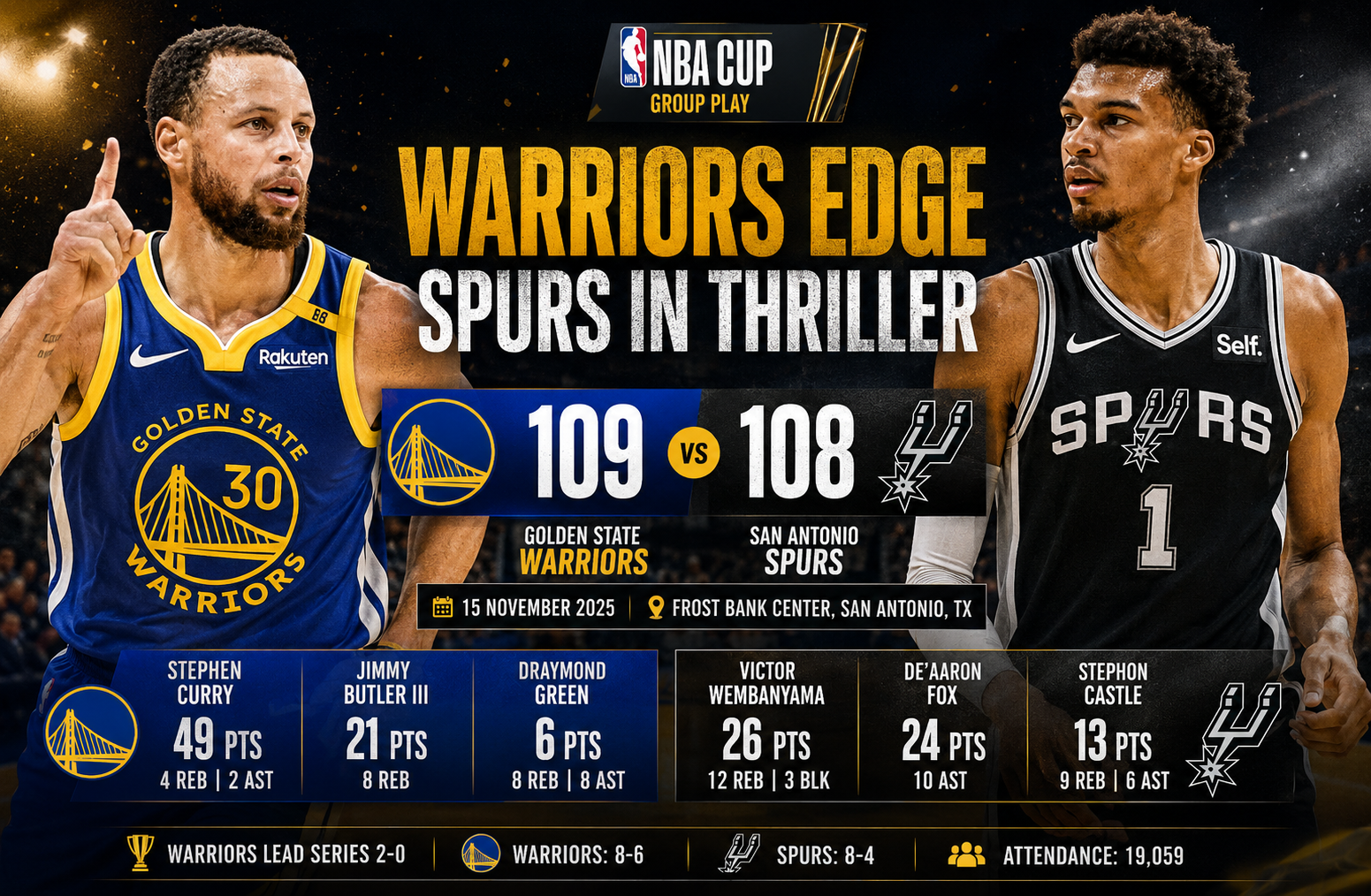
The san antonio spurs vs golden state warriors match player stats from the 2025 NBA Cup Group Play meeting tell the story of a game decided by elite shot-making, late-game execution, and a remarkable Stephen Curry performance. Golden State defeated San Antonio 109-108 at Frost Bank Center in a one-point thriller that featured 49 points from Curry, a strong all-around showing from Victor Wembanyama, and a dramatic finish that came down to the final possession. The official NBA record identifies the game as Friday, November 14, 2025, in San Antonio, while some listings show November 15 because of the UTC date conversion.
For anyone studying this matchup through a statistical lens, the final score alone does not explain why Golden State won. San Antonio actually produced several advantages that normally point toward victory. The Spurs shot 46% from the field, collected 47 rebounds, and recorded 28 assists. The Warriors, however, created enough value through three-point shooting, free-throw accuracy, lower turnover volume, and one extraordinary individual scoring performance to survive a late Spurs push.
This was also a useful example of why individual statistics need to be viewed in context. Curry’s 49 points were the headline number, but Jimmy Butler’s 21 points, Draymond Green’s playmaking and rebounding, and the Warriors’ ability to generate 17 made three-pointers all contributed to the result. On the other side, Wembanyama posted 26 points and 12 rebounds while adding four assists and three blocks, while De’Aaron Fox delivered 24 points and 10 assists.
San Antonio Spurs vs Golden State Warriors Match Player Stats: Game Overview
The matchup was part of the NBA Cup’s West Group C and took place at Frost Bank Center in San Antonio. Golden State came away with a 109-108 victory after trailing at several points during a tightly contested game. No team led by more than 10 points, which helps explain why the contest remained competitive until the final seconds.
| Category | Golden State Warriors | San Antonio Spurs |
| Final Score | 109 | 108 |
| Q1 | 18 | 20 |
| Q2 | 29 | 25 |
| Q3 | 30 | 34 |
| Q4 | 32 | 29 |
| Field Goals | 38-90 | 39-85 |
| Field Goal % | 42% | 46% |
| Three-Pointers | 17-45 | 14-38 |
| Three-Point % | 38% | 37% |
| Free Throws | 16-18 | 16-19 |
| Free Throw % | 89% | 84% |
| Total Rebounds | 39 | 47 |
| Assists | 18 | 28 |
| Turnovers | 14 | 20 |
| Steals | 9 | 8 |
| Blocks | 8 | 6 |
| Personal Fouls | 20 | 19 |
The most obvious statistical contrast is efficiency versus volume. San Antonio shot better overall and dominated the glass, but Golden State made three more three-pointers while taking seven more attempts from beyond the arc. That difference was significant because the Warriors converted 17 of 45 three-point attempts, while the Spurs made 14 of 38.
The turnover margin was another important factor. San Antonio committed 20 turnovers compared with 14 for Golden State. In a one-point game, six additional turnovers can have an enormous impact because every lost possession removes an opportunity to score and can create transition chances for the opponent.
The Spurs also had a clear advantage in ball movement. Their 28 assists compared with 18 for Golden State show how effectively San Antonio distributed the ball. Yet the Warriors’ offense ultimately relied more heavily on individual shot creation, with Curry producing a game-high 49 points.
That contrast is one of the most interesting parts of the statistical profile. San Antonio generated more balanced offensive involvement, while Golden State leaned heavily on its superstar to create separation.
Stephen Curry’s 49-Point Performance
The defining number in the san antonio spurs vs golden state warriors match player stats was Stephen Curry’s 49 points.
Curry finished 16-for-26 from the field, 9-for-17 from three-point range, and 8-for-8 from the free-throw line. His nine made three-pointers were particularly important because they gave Golden State a reliable source of high-value scoring against a Spurs team that was otherwise more efficient from the field.
The timing of Curry’s production was just as important as the final total.
According to the official game recap, Curry scored 31 points in the second half. That means his offensive impact increased as the game moved toward its most important possessions. In a contest that ended with a one-point margin, that type of late scoring becomes especially valuable.
Curry’s performance also demonstrated the difference between scoring volume and scoring efficiency. He did not simply take a large number of difficult shots. He converted 16 of 26 attempts from the field, while also making nine three-pointers and all eight of his free throws.
His three-point shooting was arguably the biggest statistical pressure point for San Antonio. The Spurs had a strong overall field-goal percentage, but Golden State’s ability to consistently convert from deep allowed the Warriors to keep pace even when San Antonio controlled other areas of the game.
The final moments provided the clearest example of Curry’s value. With San Antonio leading 108-107, Curry was fouled by De’Aaron Fox and made both free throws with six seconds remaining. Those two points gave Golden State a 109-108 lead. Fox then missed a potential game-winning jumper at the buzzer.
From a statistical perspective, this is why Curry’s 49-point line should not be viewed as just another high-scoring performance. His points directly influenced the final margin, and his free throws in the closing seconds produced the winning score.
Victor Wembanyama’s Complete Statistical Impact
Victor Wembanyama led San Antonio with 26 points and 12 rebounds. The official NBA and AP game records also credit him with four assists and three blocks, making his performance much more than a simple scoring contribution.
His 12 rebounds were especially important because San Antonio finished with a 47-39 advantage on the boards. Wembanyama’s presence helped the Spurs control the glass and create additional opportunities throughout the game.
His defensive impact was equally notable.
Wembanyama recorded three blocks, and one of the most important came late in the fourth quarter. With San Antonio leading 108-107 and 33 seconds remaining, Wembanyama blocked a Jimmy Butler layup attempt. That play appeared to put the Spurs in position to close out the game.
The problem was that San Antonio could not convert the resulting opportunity into a decisive offensive possession.
The Spurs failed to score on their next possession, and Fox missed a mid-range jumper with 12 seconds left. Curry then drew the foul that produced the two game-winning free throws for Golden State.
This sequence illustrates an important lesson when analyzing player statistics. A defensive play can be excellent and still fail to determine the outcome if the offense does not capitalize afterward.
Wembanyama’s 26-point, 12-rebound, four-assist, three-block line was outstanding. Yet the final result shows that individual excellence does not always translate into victory, especially when the opponent has a player capable of producing an extraordinary scoring night.
De’Aaron Fox’s 24 Points and 10 Assists
De’Aaron Fox was another major contributor for San Antonio, finishing with 24 points and 10 assists. His double-double reflected the dual role he played as both a scorer and primary creator.
The 10 assists were particularly significant because San Antonio finished with 28 assists as a team. Fox’s ability to create opportunities helped the Spurs maintain offensive balance instead of relying exclusively on Wembanyama.
Fox’s playmaking also contributed to the Spurs’ strong overall field-goal percentage. San Antonio finished 39-for-85 from the field, or approximately 46%, compared with Golden State’s 38-for-90, or approximately 42%.
However, Fox’s final possession became part of the game’s story.
After Curry made the two free throws that put Golden State ahead, Fox had an opportunity to win the game at the buzzer. His jumper missed, allowing the Warriors to escape with a one-point victory.
It would be unfair to judge Fox’s entire performance by that final shot. His 24 points and 10 assists were major reasons San Antonio remained in position to win. The broader statistical picture shows a productive offensive game from the Spurs guard, even though the final possession did not go his way.
Jimmy Butler’s 21 Points and Rebounding
Jimmy Butler III finished with 21 points and eight rebounds for Golden State. His 8-for-? shooting profile in the supplied data should be treated carefully, but the official NBA box score confirms that he scored 21 points and collected eight rebounds.
Butler’s contribution was important because Golden State needed secondary scoring alongside Curry.
A 49-point performance from Curry can dominate the box score, but a player cannot realistically win a one-point NBA game without support. Butler provided that support with 21 points and eight rebounds.
His rebounding also helped Golden State limit the damage caused by San Antonio’s size. The Spurs finished with 47 total rebounds, eight more than the Warriors. Butler’s eight boards were therefore valuable in a game where Golden State was generally at a disadvantage on the glass.
The late blocked shot against Butler also became one of the game’s key moments. Wembanyama rejected his attempt at the rim with San Antonio holding a one-point lead. Golden State still recovered because Curry created the winning possession shortly afterward.
Draymond Green’s All-Around Influence
Draymond Green did not produce a huge scoring total, but his statistical profile showed why his impact cannot be judged through points alone.
Green finished with six points, eight rebounds, and eight assists according to the supplied game data. His eight assists were particularly valuable for a Warriors team that finished with only 18 total assists.
This creates an interesting contrast with San Antonio.
The Spurs recorded 28 assists as a team, 10 more than Golden State. Yet Green individually accounted for eight of Golden State’s assists, meaning a significant portion of the Warriors’ half-court organization came through one player.
Green’s rebounding also helped offset the Spurs’ frontcourt advantage. His eight rebounds matched Butler’s team-leading total for Golden State.
The game also featured a physical battle between Green and Wembanyama. The official recap noted that the two had to be separated multiple times while fighting for position during the fourth quarter. Green later picked up his fifth foul.
That physical matchup was important because it reflected the broader tactical challenge facing Golden State. The Warriors had to deal with Wembanyama’s size and defensive presence without allowing the Spurs’ big man to control every possession.
Green’s value came through several categories at once: rebounding, passing, defensive physicality, and veteran decision-making.
Stephon Castle’s 13 Points, 9 Rebounds, and 6 Assists
Stephon Castle produced a versatile performance for San Antonio, finishing with 13 points, nine rebounds, and six assists according to the supplied game data.
Although his scoring total was modest compared with Curry, Wembanyama, and Fox, his rebounding and playmaking made him an important part of the Spurs’ statistical balance.
Castle’s nine rebounds were particularly valuable in a game where San Antonio won the overall rebounding battle 47-39. His ability to contribute on the glass from the perimeter helped San Antonio maintain possession and create second-chance opportunities.
His six assists also added another layer to the Spurs’ offensive structure. San Antonio’s 28 team assists showed that the offense was not built around one creator alone.
This balance was one reason the Spurs were able to shoot 46% from the field despite losing the game.
The Most Important Team Statistical Differences
The san antonio spurs vs golden state warriors match player stats become much easier to understand when the team numbers are placed side by side.
1. Three-Point Shooting Favored Golden State
Golden State made 17 of 45 three-point attempts, while San Antonio made 14 of 38.
The difference was three made three-pointers.
That may not sound enormous, but in a game decided by one point, nine additional points from made threes can have a major effect. Golden State’s 38% three-point accuracy was also slightly better than San Antonio’s 37%.
Curry was the central reason for that advantage, making nine threes by himself.
2. San Antonio Won the Rebounding Battle
The Spurs collected 47 rebounds compared with 39 for Golden State.
That eight-rebound advantage suggests San Antonio was more effective at controlling the possession battle. Wembanyama’s 12 rebounds were the biggest individual contribution in this category.
Yet Golden State compensated in other areas, demonstrating that rebounding dominance does not automatically guarantee victory.
3. The Spurs Had More Assists
San Antonio recorded 28 assists, compared with 18 for Golden State.
That 10-assist advantage is substantial.
It indicates that the Spurs generated more of their offense through collective ball movement. Fox led the way with 10 assists, while Castle added six.
Golden State’s offense was more dependent on individual creation, particularly Curry’s ability to generate efficient shots under pressure.
4. Turnovers Hurt San Antonio
San Antonio committed 20 turnovers, six more than Golden State’s 14.
That was arguably one of the most important negative statistical differences for the Spurs.
In a one-point game, six extra turnovers represent six possessions that did not produce a shot. Some may also have led directly to transition opportunities for Golden State.
The Spurs had advantages in field-goal percentage, rebounds, and assists, but the turnover differential helped the Warriors remain competitive.
5. Free-Throw Accuracy Favored Golden State
The Warriors went 16-for-18 at the free-throw line, an excellent 89%.
San Antonio went 16-for-19, or 84%.
The difference was not enormous in total makes, but the Warriors were slightly more efficient.
Most importantly, Curry made both of his free throws in the final seconds. Those two shots represented the difference between a 108-107 defeat and a 109-108 victory.
Quarter-by-Quarter Breakdown
The quarter scoring reveals how the game developed.
| Quarter | Warriors | Spurs | Quarter Winner |
| First | 18 | 20 | Spurs |
| Second | 29 | 25 | Warriors |
| Third | 30 | 34 | Spurs |
| Fourth | 32 | 29 | Warriors |
| Final | 109 | 108 | Warriors |
San Antonio opened the game with a two-point advantage after the first quarter.
Golden State responded in the second quarter, outscoring the Spurs 29-25 and entering halftime with the game effectively level.
The third quarter belonged to San Antonio. The Spurs scored 34 points compared with 30 for Golden State, creating a four-point advantage heading into the final period.
The Warriors then delivered their most important quarter.
Golden State scored 32 points in the fourth while holding San Antonio to 29. The three-point differential in the final period was enough to erase the Spurs’ advantage and set up the decisive final possessions.
This pattern is consistent with the game’s overall statistical story. San Antonio performed well for long stretches, but Golden State repeatedly answered when the margin became critical.
Why the Warriors Won Despite Shooting a Lower Field-Goal Percentage
At first glance, Golden State’s 42% field-goal shooting compared poorly with San Antonio’s 46%.
Normally, that would be a warning sign.
But basketball efficiency is not determined by field-goal percentage alone.
Golden State made more three-pointers and shot slightly better from three-point range. The Warriors also converted 89% of their free throws and committed six fewer turnovers.
San Antonio, meanwhile, had more rebounds and assists, but the team also gave the ball away 20 times.
This is the statistical profile of a team that lost despite doing many things well.
The Spurs were more efficient on standard field goals.
- They rebounded better.
- They assisted more.
- They still lost.
Golden State’s advantage came from the combination of three-point production, free-throw execution, turnover control, and Curry’s individual scoring.
This is an important lesson for anyone analyzing NBA box scores. The team with the higher field-goal percentage does not necessarily have the better offensive performance. Shot value, turnovers, offensive rebounds, and free throws all influence the final result.
The Final Two Minutes Changed Everything
The final stretch provides the clearest explanation of the result.
San Antonio led 108-107 with less than a minute remaining.
Wembanyama then made an excellent defensive play by blocking Butler at the rim with 33 seconds left.
The Spurs had a chance to extend their lead or at least force Golden State to score on a final possession.
Instead, San Antonio could not convert its next offensive opportunity. Fox missed a jumper with 12 seconds remaining.
Curry then attacked the next possession and drew a foul from Fox.
He made both free throws.
Golden State led 109-108.
Fox had one last chance to answer but missed the potential game-winning shot at the buzzer.
From a tactical standpoint, the ending demonstrates the value of late-game execution.
The Spurs’ defense did its job.
The Warriors’ offense then found the right player.
Curry converted under pressure.
San Antonio’s final shot did not fall.
That sequence explains the one-point margin more clearly than any single box-score category.
What the Player Stats Say About Each Team
The statistical evidence suggests that the two teams won in very different ways.
Golden State Warriors
Golden State’s formula was built around elite perimeter scoring and individual shot creation.
The Warriors received:
- 49 points from Stephen Curry
- 21 points and 8 rebounds from Jimmy Butler III
- 8 rebounds and 8 assists from Draymond Green
- 10 points from Will Richard
- 10 points from Brandin Podziemski
- 17 made three-pointers as a team
Curry was the clear offensive centerpiece, but the supporting numbers show that the Warriors were not entirely one-dimensional.
Butler provided secondary scoring and rebounding.
Green contributed across multiple categories.
The team also protected the ball better than San Antonio.
The result was an offense capable of surviving a lower overall field-goal percentage.
San Antonio Spurs
San Antonio’s statistical profile was more balanced.
The Spurs received:
- 26 points and 12 rebounds from Victor Wembanyama
- 24 points and 10 assists from De’Aaron Fox
- 13 points, 9 rebounds, and 6 assists from Stephon Castle
- 14 points from Julian Champagnie
- 47 total rebounds
- 28 team assists
The Spurs moved the ball well and controlled the boards.
Their biggest problem was not a lack of production. It was the combination of turnovers and late-game execution.
San Antonio had enough statistical advantages to win, but Golden State’s superstar performance and superior closing sequence proved decisive.
Understanding the Value of Usage and Efficiency
One of the most useful ways to study this game is to separate volume from efficiency.
Curry took 26 field-goal attempts and scored 49 points.
That is an enormous offensive workload, but his efficiency remained high because he made 16 shots and nine three-pointers. He also went 8-for-8 at the line.
Wembanyama, by contrast, contributed across multiple statistical categories. His 26 points were only part of his overall impact. His 12 rebounds, four assists, and three blocks show how he affected the game on both ends.
Fox’s value was similarly multidimensional. His 24 points were complemented by 10 assists.
This is why advanced basketball analysis should not rely solely on points per game or raw scoring totals.
A player can influence the outcome through:
- Shot creation
- Efficient shooting
- Rebounding
- Playmaking
- Rim protection
- Turnover control
- Defensive pressure
- Late-game execution
The Warriors had the most dominant individual scoring performance.
The Spurs had the more balanced statistical distribution.
The final result came down to which advantages mattered most in the final possessions.
What This Game Reveals About NBA Matchup Analysis
The game provides several broader lessons for people who study NBA player statistics.
Individual Stars Can Override Team-Level Advantages
San Antonio won the rebounding and assist categories and shot better from the field.
Yet Curry’s 49 points changed the equation.
This does not mean star scoring always beats balanced team play. It means that elite individual performances can significantly alter the importance of other statistical categories.
Turnovers Become More Important in Close Games
A six-turnover difference may not look overwhelming over a full season.
In a one-point game, it can be decisive.
Every turnover removes an offensive opportunity. When the game is close, those lost possessions can become more important than small differences in shooting percentage.
Three-Point Volume Can Offset Lower Overall Shooting
Golden State attempted 45 threes and made 17.
San Antonio attempted 38 and made 14.
The Warriors’ ability to generate more made threes helped compensate for their lower overall field-goal percentage.
This is one of the defining features of modern NBA offense.
Late-Game Execution Matters More Than Most Box-Score Categories
The final score was 109-108.
That means the difference between winning and losing was one point.
The most important statistical contribution may therefore have been Curry’s two made free throws in the closing seconds.
At that stage, season averages and overall shooting percentages become less relevant than execution on a handful of possessions.
Key Player Matchups
Stephen Curry vs Victor Wembanyama
This was the headline individual contrast.
Curry dominated the scoring column with 49 points, while Wembanyama produced a more balanced two-way statistical line.
Curry’s advantage was perimeter scoring.
Wembanyama’s advantage was size, rebounding, and interior defense.
The game showed how different forms of dominance can coexist in the same matchup.
Jimmy Butler III vs San Antonio’s Interior Defense
Butler scored 21 points and grabbed eight rebounds, but his late layup attempt was blocked by Wembanyama.
That moment summarized the challenge Golden State faced against San Antonio’s rim protection.
Butler’s physical style helped create opportunities, but Wembanyama’s presence made finishing at the basket difficult.
Draymond Green vs Victor Wembanyama
Green’s eight rebounds and eight assists were important against a Spurs team built around a physically imposing frontcourt presence.
The matchup was also highly physical.
Green’s ability to defend, rebound, and facilitate helped Golden State manage the size disadvantage, even though Wembanyama ultimately had the stronger individual statistical line in several categories.
De’Aaron Fox vs Golden State’s Perimeter Defense
Fox scored 24 points and delivered 10 assists, making him one of San Antonio’s most important offensive players.
However, Golden State’s defensive pressure became critical late in the game.
The Warriors forced San Antonio into a difficult final possession after Curry’s go-ahead free throws, and Fox’s potential game-winning attempt did not fall.
The Most Important Takeaways From the Box Score
If you only have a few seconds to understand the game, these are the numbers that matter most:
- Curry scored 49 points, including nine made three-pointers.
- Wembanyama posted 26 points and 12 rebounds, with four assists and three blocks.
- Fox recorded 24 points and 10 assists, giving San Antonio a second major offensive creator.
- Golden State made 17 threes, compared with 14 for San Antonio.
- San Antonio outrebounded Golden State 47-39.
- San Antonio recorded 28 assists, 10 more than Golden State.
- The Spurs committed 20 turnovers, six more than the Warriors.
- The Warriors shot 89% from the free-throw line, compared with 84% for San Antonio.
- Curry made two decisive free throws with six seconds remaining.
- The Warriors won 109-108, escaping after Fox missed a potential game-winning shot.
Together, these numbers explain why the final score was so close.
San Antonio did not lose because it played poorly.
Golden State won because its strengths were more valuable in the game’s decisive moments.
How to Read These Player Stats Correctly
A common mistake in sports content is to list every number without explaining what those numbers mean.
A better approach is to organize the statistics into four questions.
Who scored efficiently?
Curry was the standout. His 49 points came on 16-for-26 shooting, including nine made threes and a perfect 8-for-8 from the free-throw line.
Who controlled the possession battle?
San Antonio had the advantage in rebounds, 47-39.
Who controlled ball movement?
San Antonio recorded 28 assists, compared with 18 for Golden State.
Who protected possessions better?
Golden State committed 14 turnovers, while San Antonio committed 20.
This framework is more useful than simply ranking players by points.
It explains how the game was actually won.
Why the One-Point Margin Matters
The final score of 109-108 means the game was decided by one possession.
That makes every major statistical difference more meaningful.
San Antonio’s eight-rebound advantage could have been enough.
Its 10-assist advantage could have been enough.
Its superior field-goal percentage could have been enough.
But the Warriors had Curry’s 49 points, a three-point advantage in made threes, six fewer turnovers, and perfect execution from Curry at the free-throw line when the game was on the line.
The game therefore serves as a useful case study in the difference between statistical superiority and winning efficiency.
A team can lead in several categories and still lose if the opponent dominates the categories that directly influence the final margin.
Season Series Context
The victory gave Golden State a 2-0 sweep of its two-game set in San Antonio during this stretch, according to the official NBA and AP recap. The Warriors also earned their first NBA Cup Group Play victory in the game.
That context makes the result more significant than a routine regular-season win.
The matchup was part of the NBA Cup structure, where individual games can carry additional importance within group standings.
For San Antonio, the loss was particularly frustrating because the team had several statistical advantages and held a one-point lead in the closing seconds.
For Golden State, the result reinforced the value of having a veteran superstar capable of taking over a high-pressure game.
Final Statistical Assessment
The san antonio spurs vs golden state warriors match player stats show a fascinating contrast between individual brilliance and collective balance.
Stephen Curry was unquestionably the game’s biggest statistical difference-maker. His 49 points, nine three-pointers, and perfect free-throw shooting created an offensive performance that San Antonio could not fully contain.
Victor Wembanyama was excellent in his own right. His 26 points, 12 rebounds, four assists, and three blocks demonstrated his ability to influence the game in multiple ways.
De’Aaron Fox added 24 points and 10 assists, while Stephon Castle contributed across the box score. The Spurs also won the rebounding and assist categories and shot a better percentage from the field.
Yet Golden State found a way to win.
The Warriors’ 17 made three-pointers, lower turnover total, stronger free-throw percentage, and late-game execution ultimately outweighed San Antonio’s statistical advantages.
The biggest lesson is simple: close NBA games are rarely explained by one category.
The Spurs had the better overall field-goal percentage.
They won the rebound battle.
They produced more assists.
The Warriors had fewer turnovers, more made threes, and the game’s most explosive scorer.
When the contest reached its final possessions, those factors became decisive.
Curry’s two free throws with six seconds remaining changed the score from a one-point deficit to a one-point lead. San Antonio then had a final opportunity but could not convert.
That is the essence of this matchup.
The box score tells us that San Antonio played a balanced and competitive game. The final sequence tells us why Golden State won.
For readers researching player statistics, the most useful takeaway is to look beyond the headline scoring numbers. Curry’s 49 points deserved the attention, but the victory was built on a combination of perimeter shooting, possession management, free-throw accuracy, secondary contributions, and late-game execution.
That combination is what turned a game in which San Antonio led several major statistical categories into a 109-108 Golden State victory.
Frequently Asked Questions
What was the final score of the Warriors vs Spurs game?
The Golden State Warriors defeated the San Antonio Spurs 109-108 in NBA Cup Group Play at Frost Bank Center. The official NBA game page lists the local game date as Friday, November 14, 2025, while some UTC-based listings display November 15.
Who led the Warriors in scoring?
Stephen Curry led all scorers with 49 points. He shot 16-for-26 from the field, made nine three-pointers, and went 8-for-8 from the free-throw line.
Who led the Spurs in scoring?
Victor Wembanyama led San Antonio with 26 points. He also recorded 12 rebounds, four assists, and three blocks.
What were De’Aaron Fox’s stats?
De’Aaron Fox finished with 24 points and 10 assists. He was also involved in the final sequence, missing a potential game-winning jumper after Curry’s go-ahead free throws.
Which team had more rebounds and assists?
San Antonio had the advantage in both categories. The Spurs collected 47 rebounds and recorded 28 assists, compared with 39 rebounds and 18 assists for Golden State.
Why did the Warriors win?
Golden State won because it combined Stephen Curry’s 49-point performance with 17 made three-pointers, six fewer turnovers than San Antonio, strong free-throw shooting, and better execution in the final seconds. Curry’s two free throws with six seconds left put the Warriors ahead 109-108.
Conclusion
The san antonio spurs vs golden state warriors match player stats provide a clear example of how a one-point NBA game can be shaped by several competing statistical forces.
Stephen Curry delivered the defining performance with 49 points and nine made three-pointers. Victor Wembanyama answered with 26 points, 12 rebounds, four assists, and three blocks. De’Aaron Fox added 24 points and 10 assists, while Jimmy Butler III and Draymond Green provided valuable secondary production for Golden State.
San Antonio won the rebounding battle, recorded more assists, and shot a higher percentage from the field. Golden State, however, made more three-pointers, committed fewer turnovers, and executed better when the game reached its most important possessions.
The final sequence captured the entire matchup. Wembanyama made a crucial block, the Spurs failed to convert their next opportunity, Curry drew a foul and made two free throws, and Fox missed the potential game-winning shot at the buzzer.
The result was a 109-108 Warriors victory.
From a statistical standpoint, this game is a reminder that the most important numbers are not always the biggest ones. Curry’s 49 points understandably dominated the headlines, but the Warriors’ victory also depended on turnover control, three-point production, free-throw accuracy, and late-game decision-making.
San Antonio’s numbers showed a team that competed at a high level and controlled several fundamental areas of the game. Golden State’s numbers showed a team that found the right advantages at the right time.
That is ultimately what the player statistics reveal: the Spurs were statistically competitive across the box score, but the Warriors were more effective when the game was decided.